A logistics SMB owner put it to us directly: "We've been sold chatbots for two years, now everyone is talking about AI agents. What is the actual difference?"
The short answer: a chatbot responds, an agent acts. A chatbot tells you your order is late. An agent contacts the supplier, updates your ERP, and sends a notification to the customer. On its own, without you lifting a finger.
That shift is not trivial. For an SMB, it represents the difference between a communication tool and a fully autonomous digital coworker. Here is what changes on the ground, how it works, and how to identify the right use cases for your business.
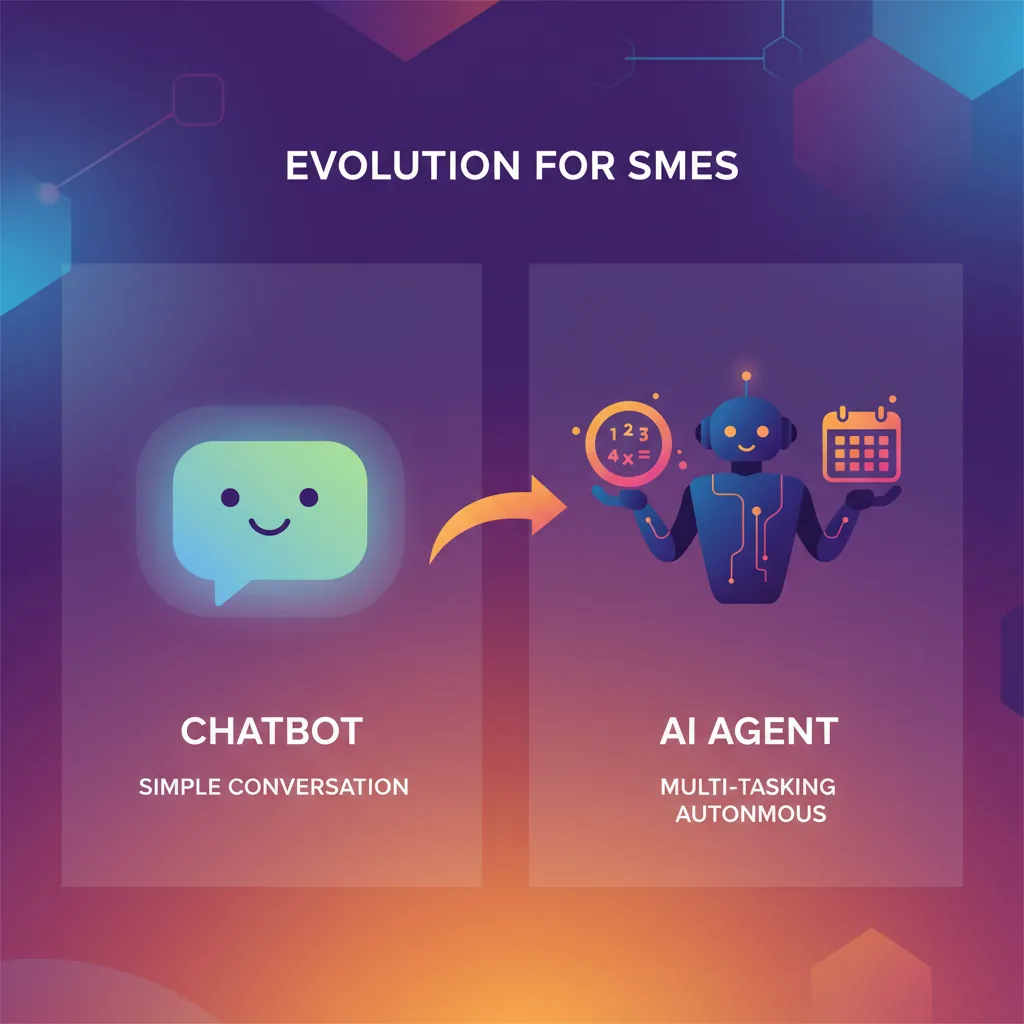
1. Chatbot or AI agent? The difference in a real situation
The confusion stems from the fact that both technologies use a language model (LLM) at their core. But their scope of action is fundamentally different.
Take a concrete scenario at a services SMB: a customer sends an email to report an error on their invoice.
- What a chatbot does: it detects the message, replies politely, explains the claims procedure, and provides a ticket number. It has no access to the accounting system.
- What an AI agent does: it reads the message, locates the invoice in your software, verifies the discrepancy, generates a credit note, sends it to the customer by email, and notifies the accounting manager if the amount exceeds a defined threshold.
The chatbot communicates. The agent resolves.
| Characteristic | Classic chatbot (RAG) | Autonomous AI agent |
|---|---|---|
| Primary role | Inform and respond | Execute and accomplish |
| Interaction mode | Reactive (waits for a prompt) | Proactive (iterates until result) |
| Tool access | Limited (read-only) | Broad (APIs, CRM, ERP, email, scripts) |
| Reasoning | Linear, single response | Reflection loop, self-correction |
| Human oversight | Required at every step | Only at critical checkpoints |
According to Gartner, 40% of enterprise applications will incorporate AI agents by the end of 2026, up from fewer than 5% in 2025. This is not a phenomenon limited to large tech companies. In construction, for example, an agent can answer technical standards questions instantly while also updating the project schedule.
2. How an AI agent works in practice
An AI agent uses what is known as an agentic workflow: a reasoning loop that allows it to progress toward a goal without waiting for instructions at every step.
Here is how that loop plays out for a concrete case (chasing unpaid invoices):
- Goal analysis: the agent receives the task "process invoices overdue by more than 30 days" and identifies the relevant accounts in the accounting system.
- Action selection: for each customer, it evaluates the context (history, amount, commercial relationship) and selects the appropriate follow-up message, from the most cordial to the most firm.
- Execution: it sends the emails, logs the actions in the CRM, and schedules subsequent follow-ups.
- Self-correction: if a customer replies that they have already paid, the agent verifies in the accounting system, updates the record, and automatically stops for that contact.
This cycle reduces errors and completely offloads the administrative team from these recurring tasks. Across the SMBs we work with, this type of workflow frees up 10 to 20 hours per week on accounts receivable management alone.
3. Multi-agent architectures: when multiple AIs collaborate
For more complex processes, you can have several specialized agents work together. This is called a multi-agent architecture. Each agent has a precise role and passes its work to the next.
An example applied to sales prospecting at an industrial SMB:
- An "Analysis" agent identifies target companies based on sector and financial criteria.
- A "Drafting" agent writes a personalized message drawing on recent news about each prospect.
- A "Validation" agent checks message compliance and submits the send to a salesperson for approval before dispatch.
Observed result across our clients: 60 to 70% of commercial time freed up on cold prospecting phases, with open rates significantly higher than non-personalized campaigns.
McKinsey estimates that generative AI could automate 60 to 70% of professional tasks. Multi-agent architectures are today the most effective vehicle for that. For cases where the agent needs to query an internal document base, RAG is the essential complementary layer. See our RAG systems service built for businesses that need grounded, document-aware agents.
4. Where to deploy an AI agent first in an SMB
The core rule: target high-frequency processes with low human added value and measurable impact. Here are the three areas where ROI is fastest.
Prospecting and sales qualification
An agent can manage the top of the sales funnel end to end: lead identification, semantic qualification, personalized message drafting based on target news, automatic appointment booking. Sales teams focus exclusively on qualified meetings. Observed gain: up to 75% of commercial time freed up during outreach phases.
Tier-2 customer support
A RAG chatbot answers frequently asked questions. An agent, on the other hand, triggers a refund in Stripe, modifies an order in your e-commerce platform, or sends a delivery note by querying your logistics system. Customer satisfaction increases because the problem is resolved, not just acknowledged. Companies that have made this transition consistently see a 40 to 60% reduction in tickets handled manually. For a detailed architecture walkthrough, see our article on tier-1 support AI agents with RAG, covering confidence thresholds, ticket anonymization, and Zendesk/Freshdesk/Intercom integrations.
Administrative management and invoicing
Bank reconciliation, accounts receivable follow-ups, automated generation of multi-source financial reports. This type of agent delivers visible gains from the first weeks of deployment.
Real-world result
In an industrial SMB we worked with, a multi-agent prospecting workflow freed up 60% of the commercial team's time on cold outreach within six weeks of deployment. The agents handled identification, personalization, and scheduling. The salespeople handled only the qualified meetings.
5. How to start without making the wrong call
The first mistake SMBs make is trying to automate everything at once. The second is choosing the technology before defining the problem.
The method we apply at Tensoria follows four steps:
- Process audit: identify the repetitive, low-human-value tasks that consume the most time. Our RAG systems service covers the retrieval layer needed for agents that query your internal data.
- Tool scoping: define which APIs and software the agent will have access to, and with what permissions.
- Guardrail setup: define the thresholds at which the agent must request human validation (payments, mass sends, contractual changes).
- Progressive rollout: start with the agent in "suggestion" mode before granting it full autonomy over a process.
This progression is essential for team adoption and for catching unexpected behaviors before they have consequences.
Lesson learned
The companies that get the most out of AI agents are not those that deployed the most sophisticated system first. They are those that identified one well-scoped process, measured the result, then expanded. Starting narrow is not a limitation, it is the fastest path to measurable ROI.
6. Conclusion
AI agents and chatbots are not in competition. They address different needs, and often complementary ones. The real question for an SMB is not which technology is most advanced, it is which processes are most valuable when automated. That is exactly what we do in our audits.
For a concrete example of agentic AI applied to B2B prospecting, see our deep-dive on B2B prospecting AI agent architecture. To understand how to orchestrate multiple agents in parallel, see our comparison of multi-agent orchestration approaches. And if you want to understand the boundary between structured workflows and true agent autonomy, our article on workflow vs AI agent: when to use which walks through the decision criteria.
Talk to an engineer
Not sure whether your use case needs an agent? We will map your workflows in one call.
FAQ: AI agents vs chatbots
Further reading
- Enterprise RAG Use Cases and ROI: why RAG is the knowledge layer your future agents need to be accurate.
- AI Audit: Method and Cost: how to assess your process maturity before automating anything.
- Optimize a RAG System: 5 Levers: make the data your agents rely on more reliable.
- Workflow vs AI Agent: When to Use Which: the decision criteria for choosing structured automation over true agent autonomy.
- Automating Business Tasks with AI: tools, methods, and risks for getting started the right way.
- B2B Prospecting AI Agent Architecture: a concrete example of a multi-agent pipeline applied to commercial prospecting.
- Multi-Agent Orchestration Comparison: how to orchestrate multiple agents in parallel and which frameworks to use.
- Agentic RAG: when an AI agent takes over document retrieval decisions autonomously.
- Tier-1 Support AI Agent with RAG: full architecture for a support agent that resolves tickets, not just classifies them.
- AI agents service: end-to-end deployment of autonomous agents, scoping, guardrails, integration, and rollout.
- AI audit: structured review of your workflows to identify where agent autonomy creates the most value.